Meet Eletive AISmarter surveys, safer feedback and instant answers from Eletive Copilot. AI woven into every part of the platform, built to support people decisions, not make them.
You run reviews every year, but are they actually changing how people work? These 7 tools are built to make sure they do. You'll find automated cycles, self-assessments, 360 inputs, and analytics that give both sides a shared view of progress.
Quick summary
#
Tool
Best for
Starting price
1
Eletive
Organisations that want performance reviews and employee engagement data in the same platform
Contact sales
2
PerformYard
Mid-size teams that need flexible review cycles
$5/person/month
3
Lattice
Reviews, succession planning, and compensation in one platform
That disconnect runs from the boardroom to the desk. The process exists in most organisations, but the tools behind it aren't doing the job. Annual forms in a spreadsheet or a generic HRIS module can't automate review cycles or pull in 360 feedback. And they can't show a manager and employee how their ratings compare side by side.
We've compared 7 employee performance review software tools on the features that decide whether reviews drive growth or collect dust.
Why listen to us?
We see Eletive not just as a tool, but as a partner in our ongoing journey to enhance employee engagement
AkzoNobel runs Eletive across its global workforce, with close to 90% survey participation and 43,000 employee comments. SD Worx uses the platform for over 10,000 employees across 27 countries. That's the vantage point behind this guide.
What is performance review software?
Performance review software is a platform that structures and automates formal employee evaluations. It handles the manual work of scheduling review cycles, collecting self-assessments and manager ratings, gathering 360-degree feedback, and storing everything in one place.
Most tools also add calibration features so managers can compare ratings across teams, along with analytics dashboards and templates that standardise what gets evaluated.
It's about getting performance reviews out of the admin backlog. With the right tool, managers and employees can track goals alongside reviews and use that data in conversations that change how people work.
If you're looking for tools that cover the full performance management lifecycle beyond just reviews, see our separate guide.
Why is performance review software important?
Reviews without structure fall apart at scale: When each manager runs reviews differently, ratings become inconsistent, and there's no way to calibrate. That's where online performance review software comes in. It standardises the process so every employee gets evaluated against the same criteria.
Manual cycles burn administrative hours: Chasing forms, sending reminders, and compiling results by hand takes weeks. You shouldn't have to do any of that. Automated workflows cut it to days.
Feedback loses value when it's delayed: A rating delivered 6 months after the behaviour it's about doesn't change anything. Tools that support continuous check-ins and 1:1s keep feedback close to the moment it matters.
Employees and managers want to see where they stand:Deloitte's 2025 Global Human Capital Trends survey found that 61% of managers don't trust their organisation's performance process. Transparent, structured reviews rebuild that trust.
Unstructured reviews can make performance worse: Research by Kluger and DeNisi (1996) found that roughly a third of traditional feedback approaches lowered performance. The right software won't let that happen. It guides managers toward specific, balanced evaluations.
7 best performance review software tools
#
Tool
Best for
Starting price
1
Eletive
Organisations wanting reviews tied to engagement data
Custom quote
2
PerformYard
Mid-size teams needing flexible review cycles
$5/person/month (annual)
3
Lattice
Reviews, succession planning, and compensation in one
$10/seat/month (annual)
4
Leapsome
Modular reviews with goals, surveys, and learning
From EUR 199/month
5
15Five
Manager enablement alongside structured reviews
$11/user/month (annual)
6
Primalogik
Small to mid-size teams wanting a focused review tool
Custom quote (30-day trial)
7
AssessTEAM
Budget-conscious teams with pre-built templates
From $2/user/month
1. Eletive
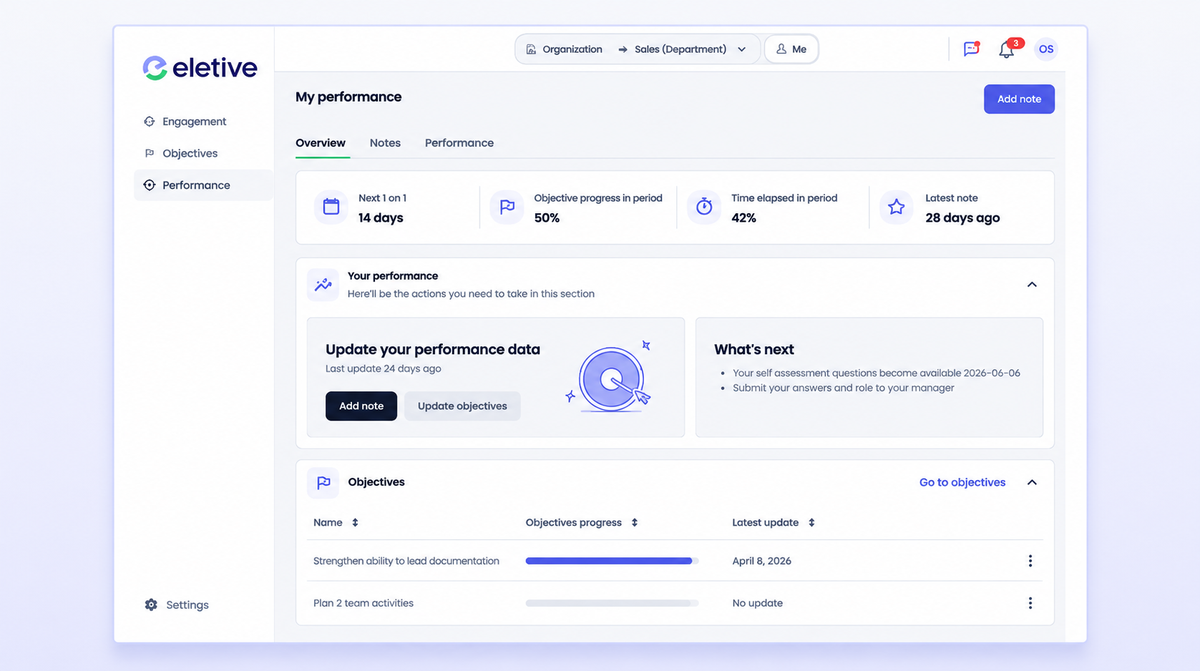
Eletive is an employee engagement and performance management platform that connects real-time pulse survey data with structured performance reviews. Most review tools treat the assessment as a standalone event. Performance Assessments run inside a continuous loop, where engagement data from pulse surveys feeds into the review conversation.
Performance assessment splits into sections that build on each other. "Looking back" covers performance and core values, while "Co-worker and manager cooperation" and "Looking ahead" move into collaboration and individual development. Manager and employee answer the same rating questions on a five-point scale. The results display side by side, so both people can see where they agree and where they don't.
An AI writing assistant suggests phrasing based on notes logged over the review period. Managers also get a private preparation area where they can draft observations before sharing anything. A cycle overview dashboard tracks completion across the organisation, so HR can see at a glance who has submitted and who hasn't.
Performance Assessments: Run structured review cycles with manager and employee ratings displayed side by side on a five-point scale.
AI writing assistant: Generate suggested phrasing for self-assessments based on notes and data logged during the review period.
360-degree feedback: Collect feedback from peers, direct reports, and cross-functional colleagues for a fuller picture beyond the manager's view.
OKRs and goal tracking: Set objectives that connect individual targets to team and company goals, with progress visible from the "My performance" dashboard.
Engagement-to-performance loop: Feed real-time pulse survey data into the review so managers have context on morale, engagement drivers, and attrition risk before they assess.
Cycle overview: Monitor assessment progress across the organisation with a dashboard showing manager submissions, employee submissions, and completions.
Private preparation notes: Give managers a private workspace to draft observations before the review, with full control over what gets shared.
Pros
Reviews are connected to live engagement data, so managers walk into assessments with context on team morale and participation
The side-by-side rating view shows where a manager's assessment and an employee's self-assessment diverge
Supports 40+ languages and kiosk access, so frontline and deskless employees aren't excluded from the review process
Cons
Performance Assessments are an add-on, so what you'll pay depends on which tier and features you pick
It's newer to standalone performance reviews, with deeper roots in engagement surveys and pulse data
Pricing
Eletive offers 3 tiers (Essential, Standard, and Professional) with performance modules available as add-ons. Pricing isn't published on the site. Contact sales for a quote.
Rating
Eletive holds a 4.5/5 rating on G2 based on 258 reviews.
2. PerformYard
PerformYard is a performance review platform built for mid-size organisations that want structured review cycles without a complicated setup. It's focused on reviews, goal tracking, and feedback without bundling in engagement surveys or HRIS modules.
The review builder lets you configure cycles with any combination of self-reviews, manager reviews, upward reviews, and peer feedback. Templates are customisable, and automated workflows send reminders and collect responses so HR isn't stuck chasing people. Once those reviews are in, calibration and 9-box grid tools let leadership compare ratings across teams.
Key features
Flexible review cycles: Build cycles with any mix of self, manager, upward, and peer assessments on whatever cadence you need.
Calibration and 9-box: Compare ratings across managers and departments using calibration views and a 9-box talent grid.
Continuous feedback: Send and receive feedback outside formal review cycles to keep conversations going year-round.
Goal management: Set and track goals with progress updates that tie directly into the review process.
Pros
The review builder is genuinely flexible and doesn't force a single format, so you can match whatever cycle your organisation already runs
At $5/person/month, that's among the lowest for a dedicated review platform with calibration
Support response times are consistently rated highly on G2, with multiple reviews citing fast turnaround
Cons
No built-in engagement surveys or pulse data, so you'll need a separate tool to connect reviews with employee sentiment
The platform focuses on reviews and goals and doesn't include HRIS, payroll, or compensation features
Reporting and analytics aren't as visually polished as some larger platforms
Pricing
Perform: $5/person/month (billed annually)
Engage and Perform: $9/person/month (billed annually)
Professional: $12/person/month (billed annually)
Enterprise: $15/person/month (billed annually)
Rating
PerformYard holds a 4.7/5 rating on G2 based on 1,261 reviews.
3. Lattice
Lattice is a people management platform that covers performance reviews, goals, compensation, and engagement in a single product. It's a popular choice for companies that want to connect review outcomes directly to promotion and pay decisions.
Lattice covers self-assessments and manager reviews, and it goes further than most by building peer feedback and upward reviews into the same cycle. You'll also find talent reviews and succession planning alongside performance improvement plans. Calibration tools let managers and HR compare ratings across the organisation before they're finalised.
Key features
Customisable review cycles: Configure reviews with self, manager, upward, and peer inputs on any schedule, with automated reminders and deadlines.
Talent reviews and succession planning: Identify high performers and flight risks across the organisation and plan for leadership transitions.
Compensation management: Connect review scores directly to compensation decisions, including merit increases and bonus calculations.
Engagement surveys: Run pulse surveys and eNPS alongside performance data so review conversations have engagement context.
Pros
There's a direct line from review outcomes to compensation, which saves time and closes the gap between evaluation and action
Talent reviews and succession planning are built in, so organisations don't need a separate system for those
Highly customizable surveys and performance reviews
Cons
That's a $4,000 annual minimum, which makes it steep for small teams even at the $10/seat starting price
The platform's breadth means a learning curve, especially for managers who only need the review module
The reporting interface takes time to learn and customise
Pricing
Performance ($10/seat/month): Goals & OKRs ($8/seat/month) and Engagement ($4/seat/month) are priced as separate products, with Compensation and Grow as paid add-ons.
Enterprise: Pricing varies based on seats, complexity, and scale. Contact sales for details.
Custom packages can be curated by paying for individual base products (Performance, Goals & OKRs, and Engagement) according to your business's needs. Other modules (Compensation and Grow) are priced separately as add-ons.
Rating
Lattice holds a 4.6/5 rating on G2 based on 4,123 reviews.
4. Leapsome
Leapsome is a modular people enablement platform based in Berlin that covers reviews, goals, engagement surveys, learning, and compensation. Organisations pick the modules they need, so you don't pay for features you won't use.
Leapsome's reviews go beyond the standard cycle. You can run 360 feedback, project-based reviews, and even anonymous leadership reviews. AI agents summarise feedback and draft performance summaries for managers to edit, which cuts down on the time they spend writing from scratch.
Key features
Modular review cycles: Choose from 360, project-based, probation, and anonymous leadership reviews with configurable questions, timelines, and participants.
AI review agents: Summarise feedback across reviews, flag patterns, and draft performance summaries for managers to edit.
Goals and OKRs: Set individual and team objectives that connect to the review process, with alignment views across the organisation.
Engagement surveys: Run pulse surveys alongside reviews so performance conversations are informed by employee sentiment data.
Pros
You can start with reviews only and add surveys, goals, or learning later
AI-powered summaries save managers time by consolidating feedback automatically
A 14-day free trial lets you test the platform before committing
Cons
Platform usage becomes complex as teams grow to multiple members
It's a Berlin-based company, so support and market focus are strongest in Europe
The breadth of modules can feel overwhelming during setup if you're only looking for a straightforward review tool
Pricing
Leapsome pricing scales with modules and headcount. A 14-day free trial is available. Contact Leapsome for a full quote.
Rating
Leapsome holds a 4.8/5 rating on G2 based on 2,571 reviews.
5. 15Five
15Five is a performance management platform that emphasises ongoing check-ins alongside structured reviews. It's named after its original product, a weekly check-in that takes 15 minutes for the employee and 5 for the manager.
The review side covers self-assessments and manager assessments, with 360 feedback built in. There's also a talent matrix for spotting high performers, plus coaching tools for improving manager effectiveness. AI-assisted reviews pull from the data collected in weekly check-ins, so the evaluation has months of context behind it.
Key features
AI-assisted reviews: Generate draft review content based on weekly check-in data, goal progress, and feedback collected throughout the cycle.
Talent matrix: Map employees across a performance-potential grid to identify high performers and people who need support.
Weekly check-ins: Collect structured updates every week, creating a running record that feeds directly into formal reviews.
Career paths and development: Set career development objectives and track progress alongside standard performance goals.
Pros
Weekly check-ins build a running record, so managers don't have to rely on recent memory at review time
AI-assisted reviews pull from months of check-in data, which produces more specific evaluations
The talent matrix gives leadership a clear visual of performance and potential across the organisation
Cons
The check-in model assumes regular weekly participation, which can feel like overhead for teams that aren't used to structured updates
The Engage tier at $4/user/month doesn't include reviews, so you need the Perform tier at $11/user/month for that
Some reviewers flag that analytics and reporting could go deeper for larger organisations
Pricing
Engage: $4/user/month (billed annually)
Perform: $11/user/month (billed annually)
Total Platform: $16/user/month (billed annually)
The Perform tier is needed for full review cycle features.
Rating
15Five holds a 4.6/5 rating on G2 based on 1,927 reviews.
6.
Primalogik is a performance review platform built for small to mid-size organisations that want structured reviews without the complexity of a full HR suite. It's focused on appraisals, 360 feedback, and goal tracking.
You get self-assessments and manager evaluations alongside multi-rater 360 feedback. Primalogik recently added AI-powered review summaries and assessment bias detection that flags patterns in how managers rate their teams. There's a 30-day free trial so you can test the full platform.
Key features
360-degree feedback: Collect multi-rater feedback from peers, managers, and direct reports with anonymity controls and customisable questionnaires.
AI review summaries: Generate consolidated summaries from multiple review inputs so managers can quickly see themes.
Assessment bias detection: Flag rating patterns that may indicate bias in how managers evaluate their teams.
Customisable review templates: Build templates with rating scales, competencies, and open-ended questions tailored to your organisation.
Pros
The 30-day free trial is among the longest in this category, giving you time to test with your actual team
Assessment bias detection flags patterns in how managers rate their teams, adding an equity layer to the review process
The platform is straightforward to set up and doesn't need a dedicated admin to run
Cons
The platforms UI can be less intuitive that other high-end competitors
The feature set focuses on reviews and 360 feedback, so you'll need separate tools for engagement surveys, OKRs, or compensation
The user base and review footprint are smaller than platforms like Lattice or 15Five
Pricing
Primalogik doesn't publish pricing on its site. A 30-day free trial is available. Contact Primalogik for a custom quote.
Rating
Primalogik holds a 4.7/5 rating on G2 based on 25 reviews.
7. AssessTEAM
AssessTEAM is a performance evaluation platform known for its library of over 3,000 pre-built KPIs and evaluation templates. It's built for organisations that want to start quickly without creating every template from scratch.
You can run 360-degree evaluations and project-based reviews, with continuous feedback alongside the formal cycles. It's available in multiple languages and includes mobile apps for Android and iOS. That makes it easier to keep field and remote workers in the review loop. There's a 10-day free trial available.
Key features
3,000+ pre-built KPIs: Choose from role-specific evaluation criteria across over 100 job functions, or build your own.
360-degree evaluations: Collect feedback from managers, peers, direct reports, and external stakeholders with customisable forms.
Mobile apps: Submit and review evaluations from Android and iOS apps, keeping field and remote teams in the review cycle.
Project-based reviews: Evaluate performance on specific projects, not just on fixed review cycles.
Pros
The pre-built KPI library saves significant setup time, especially for organisations with many different roles
At $2/user/month, it's one of the most affordable options in this category
Multilingual support and mobile apps make it accessible to distributed and frontline teams
Cons
The interface isn't as modern as newer platforms and takes some getting used to
Reporting and analytics aren't as deep as more established tools on this list
The smaller review footprint on G2 and Capterra means less independent user feedback to go on
Pricing
Basic: $2/user/month (billed annually)
Premium: $3/user/month (billed annually)
Enterprise: Custom pricing
Rating
AssessTEAM holds a 4.2/5 rating on G2 based on 233 reviews.
1. Cycle automation was the baseline. Every tool needed to automate review scheduling, reminders, and completion tracking without manual chasing.
2. Review templates and customisation mattered because no two organisations evaluate people the same way. We checked how flexible the templates, rating scales, and question formats were.
3. Self-reviews and 360 inputs were required. If a tool only supports top-down manager reviews, it's missing the self-assessment and peer feedback that round out the picture.
4. Calibration and analytics separated the dedicated review tools from the basic ones. We looked at whether you could compare ratings across teams and spot trends, not just whether the tool had a dashboard.
How to choose the right performance review software for your business
If you want reviews connected to engagement data, Eletive's performance-to-engagement loop gives you context no standalone review tool can offer.
For a focused, affordable review tool with strong calibration, PerformYard starts at $5/person/month and does the job well.
Need reviews, compensation, and succession planning under one roof? Lattice covers the broadest scope, though you'll pay a higher price floor for it.
European organisations looking for a modular approach should look at Leapsome. It lets you start with reviews and add modules over time.
And if the budget's tight and you need pre-built templates fast, AssessTEAM at $2/user/month is the lowest-cost way in.
Start running reviews that drive growth
You'll see within a quarter whether your reviews are improving performance or just ticking a box. Automated cycles and real-time analytics give you that answer before the next conversation starts.
Eletive connects performance reviews with engagement data, so you'll start every assessment with context on how your people are doing. Book a demo to see how it works.
Frequently asked questions
What is the best performance review software?
+
If you want reviews connected to live engagement data, Eletive is the strongest option. For mid-size teams that need a focused, affordable review tool, PerformYard gives you the best value. And if you also need compensation and succession planning in the same platform, Lattice covers the broadest ground. The right pick comes down to your review process, team size, and budget.
Can performance review software replace annual reviews?
+
It can, and many organisations use it to run more frequent cycles. 15Five is built around weekly check-ins that feed into formal reviews. Eletive and Leapsome support flexible scheduling, so you can run quarterly, bi-annual, or continuous assessments. The software doesn't force a cadence. It lets you choose one and automate it.
How much does performance review software cost?
+
It varies a lot. AssessTEAM is the cheapest at $2/user/month, while PerformYard comes in at $5/person/month and Lattice starts at $10/seat/month with a $4,000 annual minimum. Leapsome starts at EUR 199/month and scales from there. Eletive, Trakstar, and Primalogik don't publish pricing, so you'll need a sales conversation to get numbers. If you'd rather try before you buy, Leapsome offers a 14-day trial, Primalogik gives you 30 days, and AssessTEAM has a 10-day trial.
Do I need a separate review tool if my company already uses performance management software?
+
Not necessarily. Performance management software is a broader category that can include OKRs, 1:1 meeting tools, continuous feedback, engagement surveys, and compensation alongside reviews. If your platform already automates review cycles and supports 360 feedback, you may not need a separate tool. But if it handles goal-setting and check-ins without structured review workflows, a dedicated tool like PerformYard or Primalogik fills that gap. Some tools on this list, like Lattice and Eletive, cover both sides.
Do employees actually engage with performance review software?
+
Adoption depends on how it's set up and whether reviews feel useful. Automated reminders and mobile access help, and so do rating scales that are clear enough for people to use without second-guessing. Self-assessment features give employees a voice, which increases buy-in. Gallup found that only 14% of employees feel their reviews inspire improvement, but that's largely a design and culture problem. The right tool makes it easier to build a process people participate in.